

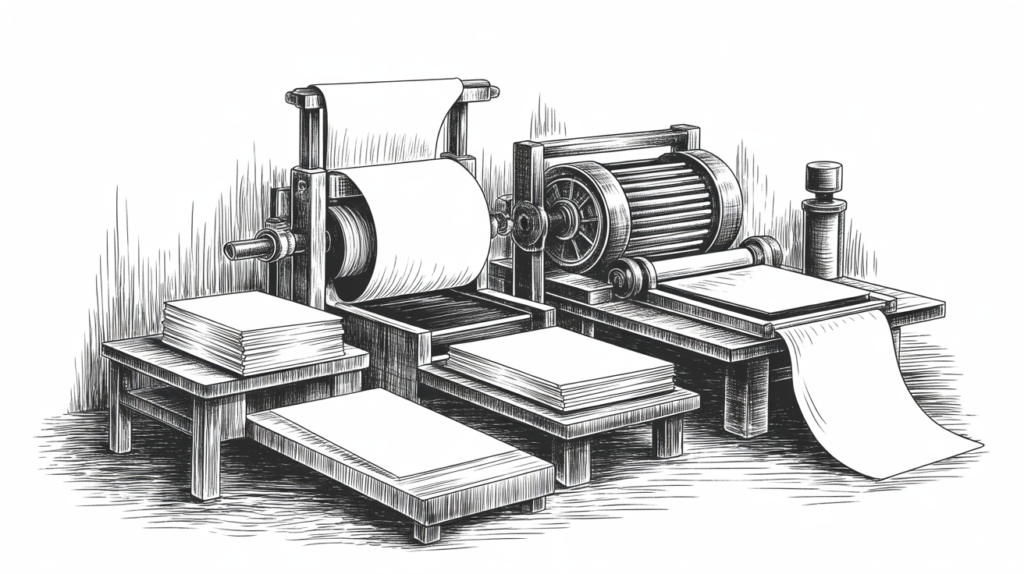
In Slovenia, digital printing starts at EUR 0.03 per sheet, offset at EUR 0.05 per unit for 5,000 copies, DTF textile printing from EUR 8 per piece and custom packaging from 300 units — all from a single provider. This guide explains which technique fits your project, what it will cost and how to prepare your files so nothing gets delayed.
Types of Printing in Slovenia
Digital Printing
Digital printing has become the standard for runs up to 1,000 copies. No plates, no lengthy setup — the file goes straight to press. Suitable for business cards, leaflets, brochures, short-run books (print on demand from 1 copy) and personalised materials where every piece is different. Prices range from EUR 0.03 for an A4 black-and-white sheet to EUR 0.25 for full colour, double-sided. For small runs (under 300 copies), digital is almost always cheaper than offset.
Offset Printing
Offset remains the king of larger runs. From 500 copies upwards, the cost per unit drops sharply — at 5,000 A4 leaflets you are below EUR 0.05 per piece. Quality is the benchmark: Pantone colours, consistency across the entire run, fine screening. For catalogues, magazines, premium brochures and anything where colour accuracy is critical, offset is the right choice.
Detailed comparison: Digital vs Offset Printing — When to Choose Which
Screen Printing
Screen printing (serigraphy) is indispensable for textile printing at larger quantities (from 50 pieces), special substrates (wood, metal, plastic) and when you need a thicker ink deposit — for example, fluorescent or metallic effects. Stencil preparation takes time, so below 30 pieces it is often too expensive.
DTF Printing
DTF (Direct to Film) is a newer technology revolutionising textile printing. The graphic is printed onto a special film, then transferred to fabric with a heat press. Advantages: no colour limitations, printing on dark and light fabrics, minimum order of 1 piece, photorealistic detail. For T-shirts, workwear and promotional textiles up to 200 pieces, it is often the optimal choice.
More details: DTF Printing — What It Is and When to Choose It
Flexographic Printing
Flexography is used for packaging — cardboard boxes, flexible films, bags, labels in runs above 3,000 units. It uses flexible printing plates and can print on uneven or flexible surfaces. In Slovenia, it is available at larger packaging houses; for smaller runs, digital packaging printing is a better route.
What We Print — Product Overview
Business Cards, Leaflets, Brochures, Posters
Classic business print materials. Business cards from EUR 25 for 100 pieces on 350 gsm card. A5 leaflets from EUR 35 for 250 copies. Brochures (saddle-stitched or perfect-bound) from EUR 0.80 per piece at 100 copies. A3 and B2 posters from EUR 2 per piece in digital print. All with delivery in 3–5 working days; express in 24 hours for an additional charge.
Books and Catalogues
Book printing from a single copy (print on demand). Softcover from EUR 5, hardcover from EUR 12 at 100 copies. Catalogues — full colour on 170 gsm coated paper, perfect-bound or saddle-stitched. For publishers, we offer the complete service: typesetting, proofreading, printing, delivery. Whether you need 1 book or 10,000, we handle both.
Packaging and Labels
Custom cardboard packaging — from prototype to production run. Roll labels, sheet labels, foil, self-adhesive stickers. Materials: chromo board, kraft, E-flute for shipping, micro-flute for lighter boxes. Prototype in 5 days, production run in 10–15 days.
More: Custom Packaging Printing — From Prototype to Production
Large Format
Large format printing: roll-up banners, PVC banners, building wraps, self-adhesive vinyl, mesh for construction sites. UV printing for outdoor use with a 3–5 year warranty. Prices from EUR 15/m² for a standard banner to EUR 45/m² for premium textile solutions.
More: Large Format Printing — What You Need to Know
Textile Printing
Textile printing: T-shirts, polo shirts, workwear, jackets, caps, bags. Technologies: DTF, screen printing, sublimation, embroidery. From 1 piece. For corporate clients: consistent quality, 7–10 day turnaround, free sample on orders over 50 pieces.
How to Prepare Files for Print
A poorly prepared file is the most common reason for delays. Here is what you need to know.
File Formats
We accept PDF/X-1a (preferred), AI (Adobe Illustrator), CDR (CorelDraw), INDD (InDesign with a packaged file) and TIFF for images. Word and PowerPoint are not suitable for professional printing — text shifts and colours change unpredictably.
Resolution and Colour Space
Images must be 300 dpi at final size. Colour space CMYK — not RGB, because print colours will not match what you see on screen. For Pantone colours, specify the PMS code. Black text: C0 M0 Y0 K100 (not registration black).
Bleed and Safety Margin
Add 3 mm bleed on each side. Text and logos must be at least 5 mm from the trim edge (safety margin). Without bleed, you risk white edges after trimming — an unacceptable standard for any print house.
Detailed instructions: How to Prepare Files for Print — In-Depth Guide
How Much Does Printing Cost?
The price of printing depends on four factors: quantity (more copies = lower unit cost), format (larger format = more material), finishing (lamination, foil stamping, spot UV add 15–40 %) and turnaround (express = +30–50 %).
| Product | Quantity | Indicative Price |
|---|---|---|
| Business cards 90×50 mm, 350 gsm | 100 pcs | from EUR 25 |
| Leaflets A5, 135 gsm | 250 pcs | from EUR 35 |
| Brochure A5, 16 pages | 100 pcs | from EUR 80 |
| Book A5, softcover, 200 pages | 100 pcs | from EUR 5/pc |
| Poster B2 | 10 pcs | from EUR 25 |
| Roll-up 85×200 cm | 1 pc | from EUR 65 |
| T-shirt DTF print | 1 pc | from EUR 12 (excl. garment) |
| Custom cardboard packaging | 100 pcs | from EUR 1.20/pc |
Digital vs offset: Up to roughly 300–500 copies, digital printing is cheaper. Above 500 copies, offset takes the lead — and the gap grows exponentially. At 5,000 copies, offset is often 50–70 % cheaper per unit.
More on the digital vs offset comparison →
How to Choose a Print Shop
Not every print shop is right for every project. Here are 7 criteria to check before placing an order.
- Range of services: Does it cover everything you need (design, printing, finishing, delivery) or will you be coordinating between 3 suppliers?
- Technology: Digital, offset, large format, textile? Specialists are often better than generalist printers for a specific product.
- Minimum order quantities: Some print shops do not print below 500 copies. For short runs, look for a digital printer.
- Turnaround time: Standard is 5–7 working days. Express 24–48 hours — not all shops offer this.
- Certifications: Fogra (colour consistency), ISO 12647 (standardised printing), FSC (sustainably sourced paper). Often mandatory for corporate clients.
- Samples: Request a sample before a large order. A serious print shop will provide one free or at minimal cost.
- Communication: Do you get a response to an enquiry within 24 hours? Do they notify you of any file issues before printing?
Location: A print shop in Ljubljana or the surrounding area means faster collection, lower shipping costs and the option to check samples in person. For standard deliveries across Slovenia, the difference is negligible.
Frequently Asked Questions
How long does printing take?
Standard turnaround is 5-7 working days from file approval. Express (24-48 hours) is available for a surcharge of 30-50%. Large format and custom packaging: 10-15 working days.
Do you print small quantities?
Yes. With digital printing, we cover runs from 1 copy — books, business cards, leaflets, brochures. For textile printing (DTF), there is likewise no minimum order.
How do I send my files for printing?
Via email (up to 25 MB) or WeTransfer/Dropbox for larger files. We accept PDF/X-1a, AI, CDR and TIFF. We check every file before printing and notify you of any required corrections.
Do you offer design services?
Yes. Our design team prepares business cards, leaflets, brochures, packaging, books — complete layout and design. Pricing depends on complexity; approximately from EUR 30 for a business card to EUR 500+ for a catalogue.
What is the difference between digital and offset printing?
Digital printing is faster and cheaper for runs up to 300-500 copies. Offset is more cost-effective for larger runs and offers a wider range of special colours (Pantone). For a detailed comparison, read our guide: digital vs offset printing.
Last updated: April 2026
Posodobljeno: 26-08-2026