

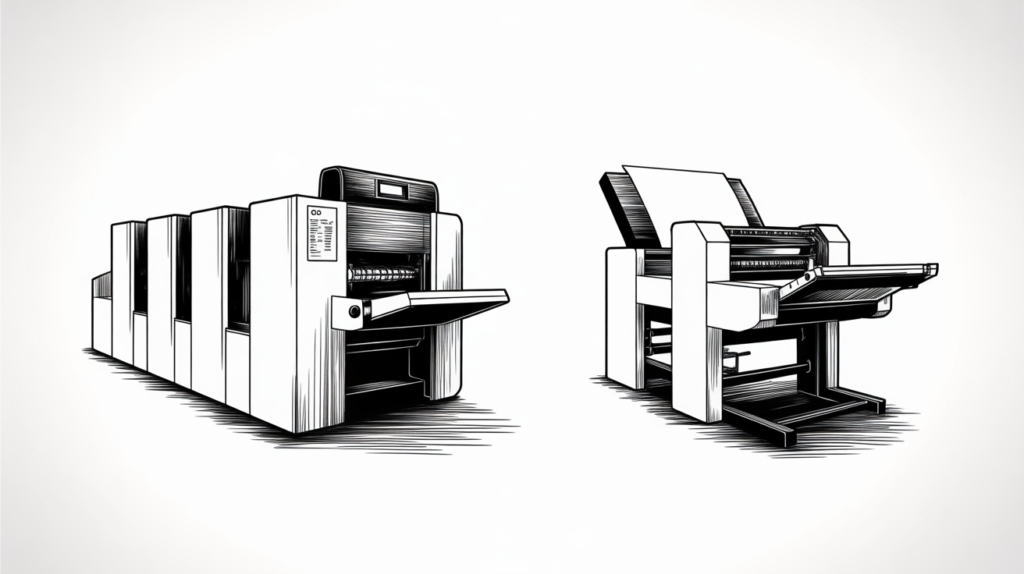
The break-even point between digital and offset printing falls at 300-500 copies: below that threshold, digital is cheaper and faster (1-3 day turnaround); above it, offset delivers a lower unit cost and superior colour consistency (Pantone, Fogra certified). For A4 leaflets, the two methods reach cost parity at approximately 400 copies.
How They Work
Digital printing transfers ink directly to paper via laser or inkjet technology. No plates, no lengthy setup. The file goes to press and the first copy is ready in 15 minutes.
Offset printing uses aluminium printing plates — one for each colour (CMYK = 4 plates). Ink transfers from the plate to a rubber blanket, then to paper. Setup takes 30–60 minutes, but once the press runs, it produces 10,000+ impressions per hour.
Comparison
| Feature | Digital Printing | Offset Printing |
|---|---|---|
| Setup | None (file → print) | Printing plates (30–60 min) |
| Minimum order | 1 copy | 300–500 copies |
| Cost for 100 A4 copies | ~EUR 15–25 | ~EUR 80–120 (plates!) |
| Cost for 5,000 A4 copies | ~EUR 250–400 | ~EUR 100–180 |
| Colour consistency | Good (98%+) | Excellent (Fogra certified) |
| Pantone colours | Simulation (CMYK) | Actual Pantone (PMS) |
| Personalisation | Yes (every copy different) | No |
| Paper range | Standard weights | Wider range (40–400 gsm) |
| Turnaround | 1–3 days | 5–7 days |
The Break-Even Point
For A4 leaflets (135 gsm, CMYK double-sided), the crossover is approximately 400 copies. Below that, digital is cheaper. Above it, offset becomes more economical — and the difference grows with every additional copy.
For heavier stock (350 gsm business cards with finishing), the threshold moves higher — to 500–700 copies. For thin paper (80 gsm leaflets), it drops to 250–300 copies.
Rule of thumb: for any project above 500 copies, request both quotes — digital and offset. Sometimes the difference is marginal; sometimes it exceeds 50%.
When to Choose Digital
- Run below 300 copies
- You need a fast turnaround (1–2 days)
- Every copy is different (personalisation, variable data)
- Test print before a larger run
- Books and brochures in short runs
When to Choose Offset
- Run above 500 copies
- You require Pantone colours (corporate identity)
- Printing on non-standard materials (premium paper, board)
- You need finishing that is cheaper in the offset process (foil stamping, embossing)
- Catalogues, magazines, annual publications
Frequently Asked Questions
Is digital print quality worse than offset?
For 95% of users, the difference is invisible. Digital printing has reached a level that satisfies even demanding clients. The difference is noticeable with Pantone colours and extremely large runs, where offset ensures better consistency.
Can I combine digital and offset printing?
Yes. A common approach: offset for the base (e.g. 10,000 leaflets), digital for personalised elements (name, QR code, unique address). This is called hybrid printing.
Why is offset cheaper at high volumes?
Because the fixed costs (plates, setup) are spread across more copies. The variable costs (paper, ink) are lower per unit in offset than in digital printing. At 5,000+ copies, the difference is dramatic.
Full overview: Complete Guide to Printing in Slovenia
Last updated: April 2026
Posodobljeno: 26-08-2026