

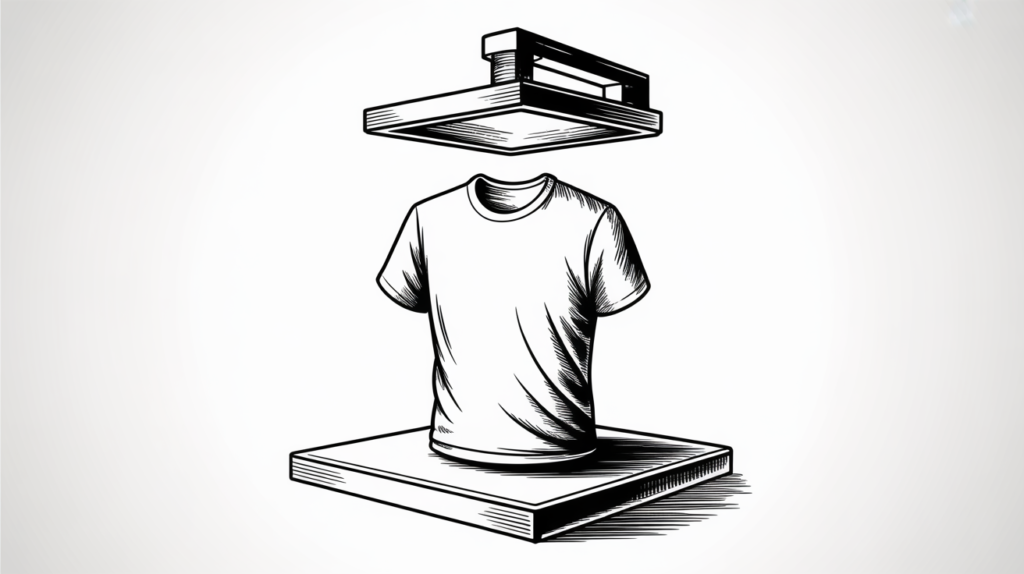
Three main textile printing techniques — DTF, sublimation, and screen printing — differ in price, quality, minimum runs, and durability. None is universally best. The right choice depends on the material, quantity, and purpose. Here is a precise comparison.
Technique comparison — overview table
| Criterion | DTF | Sublimation | Screen printing |
|---|---|---|---|
| Minimum run | 1 piece | 1 piece | 20+ pieces |
| Colours | Unlimited (CMYK) | Unlimited (CMYK) | Up to 6 (each requires its own screen) |
| Materials | All fabrics (cotton, polyester, blends) | Polyester only or polyester-coated | All fabrics |
| Wash resistance | 60+ washes | 100+ washes | 50+ washes |
| Feel | Slight relief (film on fabric) | No relief (dye in fibre) | Slight relief (ink on fabric) |
| Price/piece (1–10) | Medium (EUR 5–10) | Low (EUR 3–7) | High (EUR 15–25) |
| Price/piece (100+) | Medium (EUR 3–6) | Low (EUR 2–4) | Lowest (EUR 1.50–3) |
| Setup cost | None | None | EUR 50–150 (screen production) |
| Detail level | Photorealistic | Photorealistic | Limited to solid colours and simple gradients |
DTF (Direct-to-Film)
DTF is the fastest-growing technique in textile printing today. The process: artwork is printed onto a special film, adhesive powder is applied, and the film is transferred to fabric using a heat press.
Advantages: Works on all fabrics — white, dark, coloured. No minimum runs. Photorealistic quality. Fast turnaround (same-day printing possible).
Limitations: The film on the fabric creates a slight relief that feels different from the fabric itself. At very large runs (500+), screen printing becomes cheaper. Durability is good (60+ washes) but does not match sublimation.
Ideal for: Small and medium runs. Personalised garments (by name, unique designs). Photographs and complex artwork on dark fabrics.
Sublimation
Sublimation is a thermal process in which dye converts from a solid to a gaseous state and bonds permanently into the fibre of the fabric. The result: the colour IS the fabric, not a layer on top of it.
Advantages: Best durability (100+ washes). No relief — the fabric stays soft. Vivid, intense colours. All-over printing is possible (the entire garment surface).
Limitations: Works ONLY on polyester or polyester-coated fabrics. Does not work on pure cotton. Colours on dark fabrics are less vivid (no white base). Practically useful only on white or light polyester garments.
Ideal for: Sportswear. All-over printed garments. Promotional polyester garments in large quantities.
Screen printing
The oldest technique in this group. Ink is pushed through a mesh screen onto the fabric. Each colour requires its own screen.
Advantages: Lowest unit price at large runs (100+). Thicker ink deposit — vivid, intense colours that stand out. Works on all fabrics. Special inks available: fluorescent, metallic, glow-in-the-dark.
Limitations: Screen setup cost makes small runs expensive. Limited to 1–6 colours (each colour = new screen). Not suitable for photographs or complex gradients. Longer preparation time.
Ideal for: Large runs (100+) with simple designs (logos, slogans, 1–3 colours). Work uniforms. Promotional garments for events.
When to choose which
- 1 piece, photograph on a black t-shirt: DTF. The only technique that handles this without high costs.
- 50 polyester sports jerseys: Sublimation. No relief, top durability, all-over print.
- 500 white t-shirts with a two-colour logo: Screen printing. Lowest unit cost, excellent coverage.
- 20 t-shirts with colourful artwork on mixed fabrics: DTF. Flexible, no minimum runs.
- 5,000 promotional t-shirts for an event: Screen printing. Unmatched unit price at this volume.
Materials we print on
- 100% cotton — DTF and screen printing. The most popular material. Soft, breathable, comfortable.
- 100% polyester — sublimation, DTF, screen printing. For sportswear and functional garments.
- Cotton/polyester blends — DTF (best choice), screen printing. Sublimation performs poorly on blends.
- Nylon — DTF. For windbreakers, backpacks, bags.
- Denim — DTF. The only technique that delivers consistent results on denim.
Special considerations
White vs dark garments
On white garments, all three techniques perform well. On dark garments, DTF is the first choice — it uses a white base layer beneath the artwork, so colours pop. Sublimation on dark fabrics loses intensity. Screen printing on darks requires an additional white flash layer, which increases cost.
Print position
Standard positions: chest (left or centre), back (full or upper), sleeve. DTF and screen printing allow printing in any position. Sublimation enables all-over printing — the entire garment surface from seam to seam.
Frequently asked questions
Which technique is best for a single piece?
DTF. No setup costs, photorealistic quality, works on all fabrics and colours. The price for one piece is EUR 5–10 for printing (garment not included).
Does DTF printing survive washing?
Yes. Quality DTF printing withstands 60+ washes at 30–40 degrees C. We recommend turning the garment inside out and avoiding tumble drying. After 60 washes, slight fading is possible, but the print remains intact.
How long does t-shirt printing take?
DTF: 1–3 working days for runs up to 100 pieces. Sublimation: 2–5 working days. Screen printing: 5–10 working days (including screen production). For express orders, DTF enables same-day printing.
Read our complete Printing Guide or see our t-shirt printing service page.
More about label and sticker printing and flyer printing.
Posodobljeno: 06-10-2026