

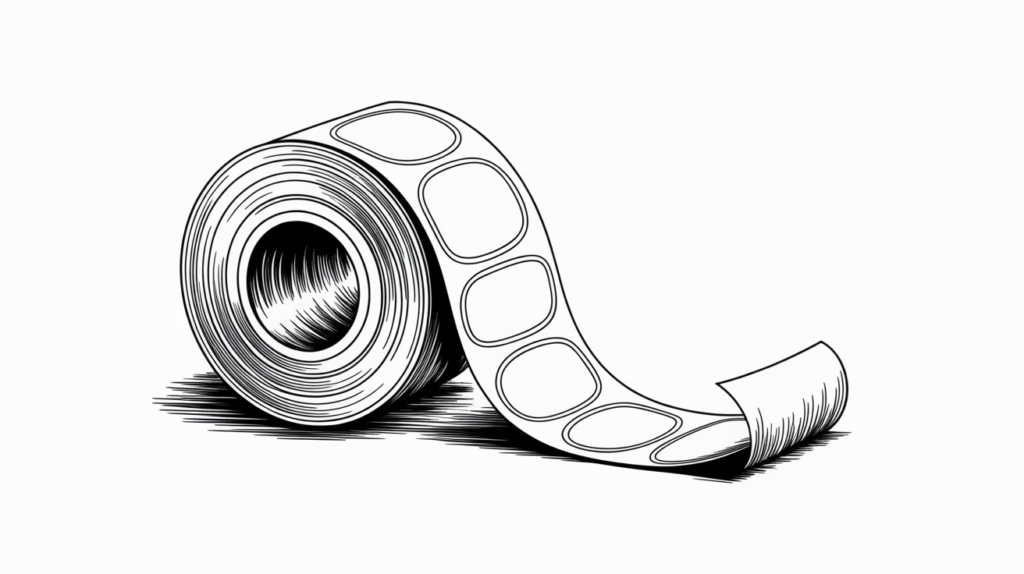
A label is not just a sticker on a product. It is the first point of contact between the customer and your brand — and often the sole reason someone picks your product off the shelf instead of a competitor’s. The choice of material, adhesive, and printing technique determines whether the label survives transport, storage, and use. Here is an overview of every option.
Label materials
| Material | Properties | Typical use | Price bracket |
|---|---|---|---|
| Paper | Matt or gloss, natural look | Food, wine, cosmetics (dry conditions) | Lowest |
| PP (polypropylene) | Waterproof, clear or white | Cosmetics, cleaning products, beverages | Medium |
| PE (polyethylene) | Soft, flexible, squeezable | Squeeze bottles (shampoos, creams) | Medium |
| BOPP | Biaxially oriented PP, exceptional durability | Industrial, outdoor use | Medium-high |
| Vinyl | UV resistant, outdoor conditions | Vehicle decals, outdoor signage | High |
Paper labels are the most affordable and visually diverse — from kraft paper for artisan products to premium coated for luxury cosmetics. But they are not waterproof. For products that come into contact with moisture, choose PP or PE.
Adhesives
The wrong adhesive causes more complaints than the wrong print. Three main types:
- Permanent adhesive — standard for most labels. Once applied, it stays. Ideal for food, beverages, cosmetics, pharmaceuticals.
- Removable adhesive — the label peels off without residue. For price labels, temporary markings, gifts where a label is unwanted.
- Freezer adhesive — holds at temperatures down to -40 degrees C. Essential for frozen food, pharmaceuticals, cold-chain logistics labels.
Specialist adhesives also exist: reinforced (for rough surfaces), recycling-friendly (for easy separation from packaging), and multi-purpose options that work across different surfaces.
Printing techniques for labels
Digital printing
No printing plates required. Ideal for small and medium runs (50–5,000 pieces), personalised labels, and prototypes. Fast turnaround — labels can be ready in 1–3 days. Colours are vibrant, resolution high (1,200 dpi). Limitation: at very large volumes, it becomes more expensive than flexo.
Flexographic printing (flexo)
The classic technique for large runs (10,000+ pieces). Lower unit cost, but requires plate production (setup cost EUR 200–500). Ideal for standardised labels ordered regularly in consistent quantities. Consistent quality across the entire run.
Combination printing
Digital + flexo, or digital + screen printing. For labels requiring special colours (Pantone, gold, silver) alongside CMYK. Used for premium labels — wine, luxury cosmetics, craft beverages.
Shapes and formats
- On rolls — for automated labelling. Machines apply labels to bottles, boxes, and tubes. The most common format for industrial use.
- On sheets — for manual application. Smaller runs, prototyping, home use. Labels are arranged on A4 or SRA3 sheets.
- Die-cut — custom shapes. Not rectangular — they follow the contour of a logo, product, or graphic. Visually striking, more expensive to produce.
Finishing options
- Matt or gloss lamination — protection against moisture, scratches, and UV. Extends label life by 2–5 years.
- Gold or silver hot foil — metallic details on the label. A logo or text in gold immediately elevates the perceived product value.
- Embossing / debossing — raised or recessed elements. Your fingers detect them. For wines and spirits, this is the premium-segment standard.
- Spot UV varnish — a glossy detail on a matt surface. Subtle but effective.
- Security features — holograms, UV inks, VOID foil. For pharmaceuticals, alcohol, and luxury goods.
Applications by industry
- Food: PP or laminated paper. Mandatory EU compliance (Regulation 1169/2011) — nutritional values, allergens, net quantity. Food-contact-approved adhesive.
- Cosmetics: PP or PE. INCI ingredient list, expiry date, batch number. Water resistance mandatory for products used in the bathroom.
- Wine: Wet-strength paper or PP. Embossing, foil stamping, premium feel. The label must survive ice and refrigerator condensation.
- Pharmaceuticals: PP with permanent adhesive. GS1 barcode, batch, expiry, security features (serialisation). Regulatory requirements are the strictest.
Frequently asked questions
What is the minimum order for label printing?
For digital printing: from 50 pieces. For flexographic printing: from 5,000 pieces (due to plate setup costs). For small test batches or prototypes, digital printing is optimal.
Can you print labels on transparent material?
Yes. Clear PP (polypropylene) is the standard material for a “no-label look”, where only the graphics are visible, not the backing. Printing with a white base layer beneath the artwork ensures the colours stand out.
How long does label production take?
Digital printing: 2–5 working days. Flexographic printing: 7–14 working days (including plate production). For express orders, digital printing enables a 1-day turnaround at smaller quantities.
Read our complete Printing Guide or see our packaging and labels page.
More about file preparation for print.
Posodobljeno: 06-10-2026