

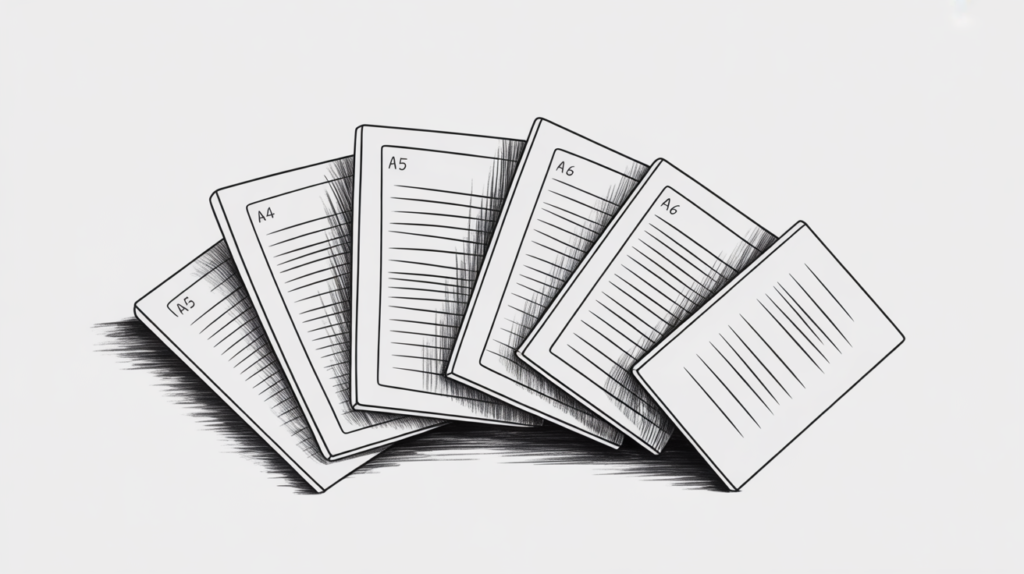
Three factors drive flyer price and quality: format, paper, and print run. The choice between digital and offset printing sets the break-even point, while finishing options add functional or visual value. Here is everything you need to know before placing an order.
Flyer formats
Standard flyer formats in Europe follow the ISO 216 system. Each format has its purpose and price bracket.
| Format | Dimensions (mm) | Typical use | Price/1,000 pcs (approx.) |
|---|---|---|---|
| A4 | 210 × 297 | Price lists, catalogues, instructions | from EUR 80 |
| A5 | 148 × 210 | Promotional flyers, invitations | from EUR 55 |
| A6 | 105 × 148 | Insert flyers, coupons | from EUR 40 |
| DL | 99 × 210 | Envelope flyers, menus | from EUR 50 |
DL format (one-third of A4) is the most common choice for direct mail — it fits perfectly into a standard C6/5 envelope. A5 is the gold standard for general distribution: large enough for readable content, small enough for cost efficiency.
Paper — weight and finish
Paper determines how a flyer feels in your hands. That tactile impression often matters more than the content itself.
Paper weights
- 130 gsm coated — standard promotional flyer. Rigid enough not to crumple in a bag, light enough for mass distribution. The most common choice for print runs above 1,000 pieces.
- 170 gsm coated — semi-premium. Noticeably sturdier than 130 gsm, still suitable for folds. Ideal for flyers the customer keeps: menus, price lists, presentation materials.
- 250 gsm coated — card-weight flyer. You do not fold it (unless scored), but use it as a mini poster or POS material. A 250 gsm flyer in hand says: “This is serious.”
Matt or gloss?
Matt paper reduces glare and looks contemporary. Gloss paper intensifies colours — photographs pop on it. For most business flyers, matt is the better choice. For flyers featuring food, fashion, or travel, choose gloss. A middle ground: matt paper with selective spot UV varnish on key elements.
Print run and pricing — comparison table
Unit price falls with quantity, but not linearly. The biggest drop is between 100 and 500 pieces.
| Print run | A5, 170 gsm, gloss (approx.) | Unit price | Turnaround |
|---|---|---|---|
| 100 pcs | ~EUR 35 | EUR 0.35 | 1–2 days |
| 250 pcs | ~EUR 45 | EUR 0.18 | 1–2 days |
| 500 pcs | ~EUR 55 | EUR 0.11 | 2–3 days |
| 1,000 pcs | ~EUR 70 | EUR 0.07 | 2–3 days |
| 5,000 pcs | ~EUR 140 | EUR 0.028 | 3–5 days |
| 10,000 pcs | ~EUR 210 | EUR 0.021 | 5–7 days |
Prices are indicative and depend on current paper and consumable costs. For an exact quote, send us your specifications.
Digital vs offset for flyers — break-even
Digital printing has no setup costs. Offset printing has higher setup costs but a lower unit price at larger volumes. Where is the threshold?
For standard flyers (CMYK, no special inks), the break-even point sits at roughly 500–1,000 pieces. Below that, digital printing is cheaper. Above it, offset delivers a better unit price and more consistent colours across long runs.
A practical rule: if you need flyers tomorrow and the quantity is under 500, go digital. If you have a week and the run exceeds 1,000, offset wins. The majority of flyer orders today go through digital printing — fast, flexible, no minimum runs.
Finishing options
- Lamination — matt or gloss film over the entire flyer. Protects against moisture and handling damage, extends lifespan. Essential for menus and materials that pass through many hands.
- Folding — single (A4 → A5), double (A4 → DL tri-fold), concertina, gate fold. Folding lets you pack three panels of content into an A4 sheet while the customer receives a compact DL flyer.
- Perforation — a tear line for easy separation. Perfect for coupons, tickets, tear-off sections. The customer tears off the coupon and keeps the flyer. Or the other way round.
- Spot UV varnish — glossy details on a matt surface. A logo or headline in varnish stands out both visually and to the touch.
- Scoring — a pressed crease for heavy papers (250 gsm and above). Without scoring, thick paper cracks and splits along the fold.
Frequently asked questions
How much does it cost to print 1,000 flyers?
For an A5 flyer on 170 gsm gloss paper, the price is approximately EUR 70 excluding VAT. The exact figure depends on format, paper, and finishing. Send your specifications via our quote form and we will respond the same day.
What paper is best for flyers?
It depends on the purpose. For mass distribution, 130 gsm coated (light, cost-effective). For business presentations, 170 gsm (professional feel). For POS materials, 250 gsm (rigid, durable). Matt for business, gloss for visually intense content.
How quickly can flyers be ready?
Digital printing: 1–2 working days for runs up to 1,000 pieces. Offset: 3–5 working days. Same-day express production is available for digital printing at smaller quantities — mention the deadline in your enquiry.
Read our complete Printing Guide for a full overview of printing services, or see our file preparation guide.
Learn more about our print shop and services.
Posodobljeno: 06-10-2026